
Moversville MentorAI Summaries💡
The moving industry’s best podcasts turned into quick, easy-to-read, actionable articles for busy moving company owners. Every summary extracts the most valuable strategies, real examples, and business lessons from the episode, so you can learn in less than 5-minutes.

From:Rotate Digital Podcast
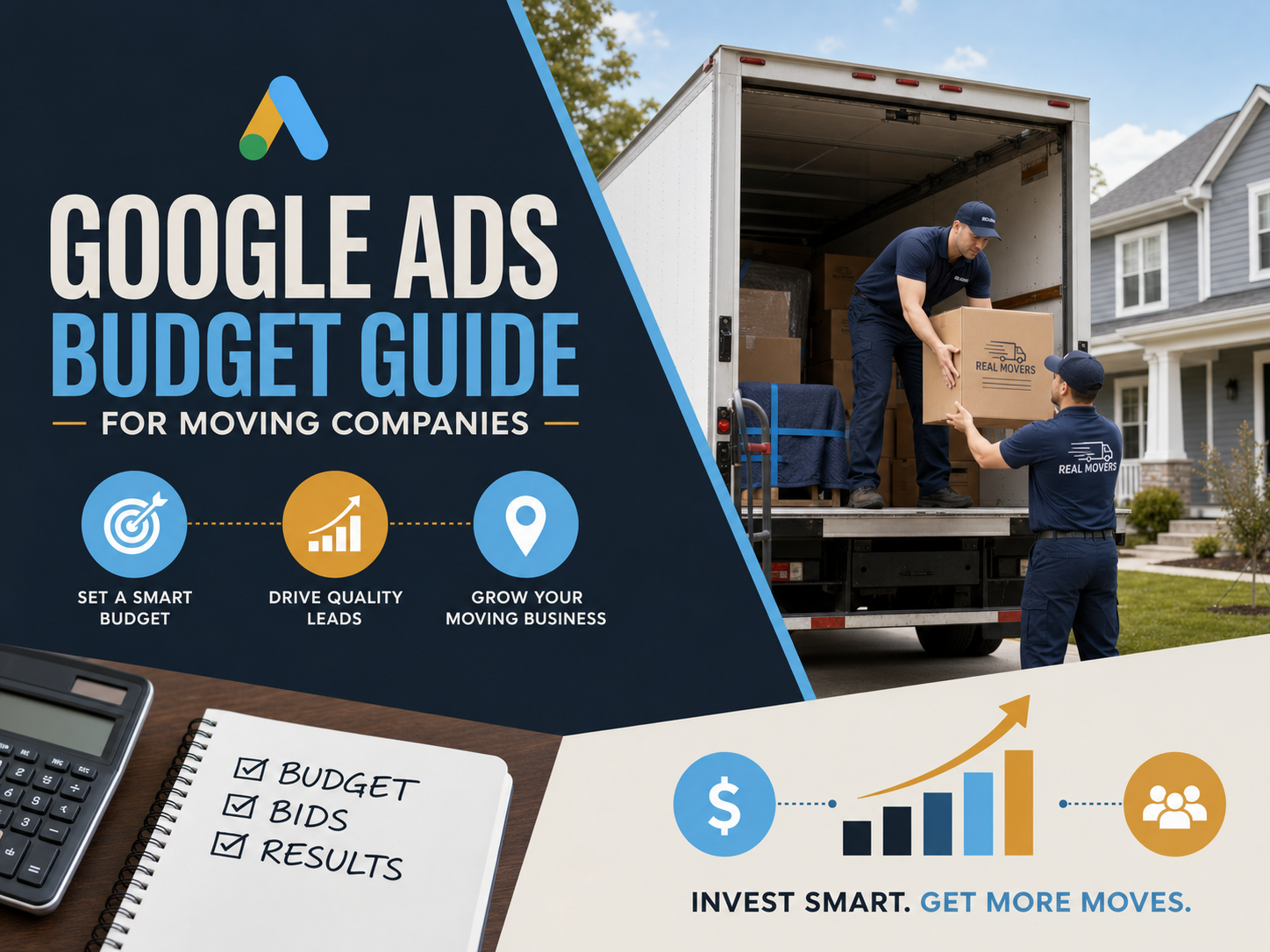
Google Ads Budget Guide for Moving Companies
Google Ads can produce profitable moving leads, but it can also burn cash fast. The problem is not always the ad platform. Many moving company owners start with a budget that is too small for their market, then Google never gets enough data to optimize.
Use this guide as a practical decision tool before you spend another dollar on moving company marketing.
How Do You Know If Your Google Ads Budget Is Big Enough?
The first number to check is your average cost per click. In the podcast example, Raleigh moving keywords showed top-of-page bids around $29, $31, and up to $40 per click. The suggested working number was $35 per click.
Why does top of page matter? Because bottom-of-page ads may show, but they may not get enough clicks to teach Google what a real moving lead looks like.
Simple Google Ads Budget Formula
- 1. Find your top-of-page cost per click in Google Keyword Planner.
- 2. Pick a realistic average CPC from the important moving keywords in your market.
- 3. Multiply by 10 clicks per day. The goal is enough traffic to learn from.
- 4. Multiply by 30.4 days. This is the monthly number Google uses.
Example: $35 CPC x 10 clicks per day x 30.4 days = about $10,640 per month.
That does not mean every moving company must spend that amount. It means that in a market like Raleigh, that was the type of budget discussed as a stronger starting point if the goal is to compete and collect data quickly.
What Happens If You Spend Too Little?
A $2,500 monthly budget sounds serious, but in a $35 cost-per-click market, it breaks down to about $82 per day. That buys around two clicks per day on average.
At that pace, Google may take a long time to understand which searches, times, and users become real moving estimates or booked jobs.
Small Budget Reality Check
- $2,500 per month may only get a few clicks per day in a competitive moving market.
- Low click volume means slower learning and weaker optimization.
- Six months of low-budget testing can still fail to break even.
- Spending $18,000 poorly creates a major opportunity cost for your moving business.
The podcast guidance was direct: in a market like Raleigh, spending less than roughly $7,000 to $10,000 on Google Ads may fail nine times out of ten. There can be lucky months, especially with strong moving sales, but it may not be consistent.
Should You Target Only High-Income Suburbs?
Many moving company owners want to target only the best neighborhoods. That makes sense emotionally. Higher-value homes can mean better jobs. But Google Ads also needs search volume.
If the area is too small, there may not be enough people searching for movers each day. You might have budget available, but not enough search activity to reach 10 clicks per day and optimize well.
Targeting Decision Guide
- If the city has enough search volume: start broader and collect data faster.
- If the suburb is high-value but tiny: be careful relying on Google Ads alone.
- If your budget is limited: avoid over-narrow targeting that slows learning.
- If you want better optimization: connect ad data to real booked jobs through offline conversion tracking.
When Does Google Ads Actually Work for Movers?
Google Ads is not a bad channel. It is a demanding channel. It works better when your moving company has enough budget, strong sales follow-up, and a way to track revenue back to the campaign.
One example shared in the podcast showed a moving company spending $42,000 on Google Ads from April to December and collecting $165,000 in revenue. That was close to a 4x return on ad spend. They closed 127 opportunities, spent about $330 per closed opportunity, and estimated around $500 profit per move, resulting in about $65,000 in profit.
Google Ads Readiness Checklist
- You can afford enough clicks to collect useful data.
- You have a strong sales process to convert moving leads into booked jobs.
- You track leads in a CRM and know which jobs came from ads.
- You are prepared for month one to be about data and break-even goals.
- You expect months two and three to focus more on optimization and profitability.
What Should You Do If Your Budget Is Around $3,000?
If your monthly ad budget is around $3,000, the podcast suggested starting with Google Local Services Ads before traditional Google Ads. LSA can be more direct because you are paying for specific leads instead of trying to train a deeper Google Ads campaign from scratch.
You should also compare that $3,000 against other local marketing channels that may give your moving company better leverage.
Alternative Places to Put a Smaller Marketing Budget
- Google Local Services Ads
- Realtor lunches
- Mailers
- Local business partnerships
- Sponsorships
- Service provider networks
- Yelp
Common Mistakes That Blow Moving Company Marketing Spend
- Starting Google Ads without checking CPC first. Use Keyword Planner before launching.
- Assuming $2,500 works in every market. Budget depends on your city, competition, and cost per click.
- Targeting too small of an area. High-value suburbs may not have enough search volume.
- Judging too early without data. Month one is often about learning, not instant profit.
- Ignoring sales performance. A weak sales team can waste even good moving leads.
- Not considering opportunity cost. Money lost in Google Ads could have funded other local marketing.
Quick Win: Run This 30-Minute Budget Test Today
- 1. Open Google Keyword Planner.
- 2. Enter your main moving keywords and your target city.
- 3. Write down the top-of-page low and high bids.
- 4. Choose a realistic average CPC.
- 5. Multiply it by 10 clicks per day and 30.4 days.
If that number is far above your real budget, do not force Google Ads. Consider LSA or local relationship marketing first.
How to Apply This This Week
- 1. Calculate your market CPC using Google Keyword Planner.
- 2. Compare your current budget against the 10-clicks-per-day formula.
- 3. Review your sales process to make sure moving estimates are followed up quickly.
- 4. Decide your best channel: Google Ads, Local Services Ads, or local partnership marketing.
- 5. Track every lead source in your CRM so you know what turns into booked revenue.
The main lesson: do not “try” Google Ads casually in a competitive moving market. Either fund it well enough to collect useful data, or put your marketing spend into a channel with better odds for your budget.
For the full discussion, watch the original video How to NOT BLOW your Marketing Spend and visit Rotate Digital | Premier SEO Agency on YouTube.
Disclaimer: At Moversville Mentor, our goal is to help moving companies learn, grow, and succeed by curating valuable industry knowledge. Our articles may draw from and build upon insights shared by experienced movers, industry experts, podcasts, interviews, and other educational sources. The content provided is for educational and informational purposes only and should not be considered legal, financial, tax, investment, or professional business advice. While we strive for accuracy, we cannot guarantee that all information is complete or up to date. Every business is different, so always consult qualified professionals before making important business, legal, or financial decisions. Any actions you take based on this content are at your own discretion and risk.