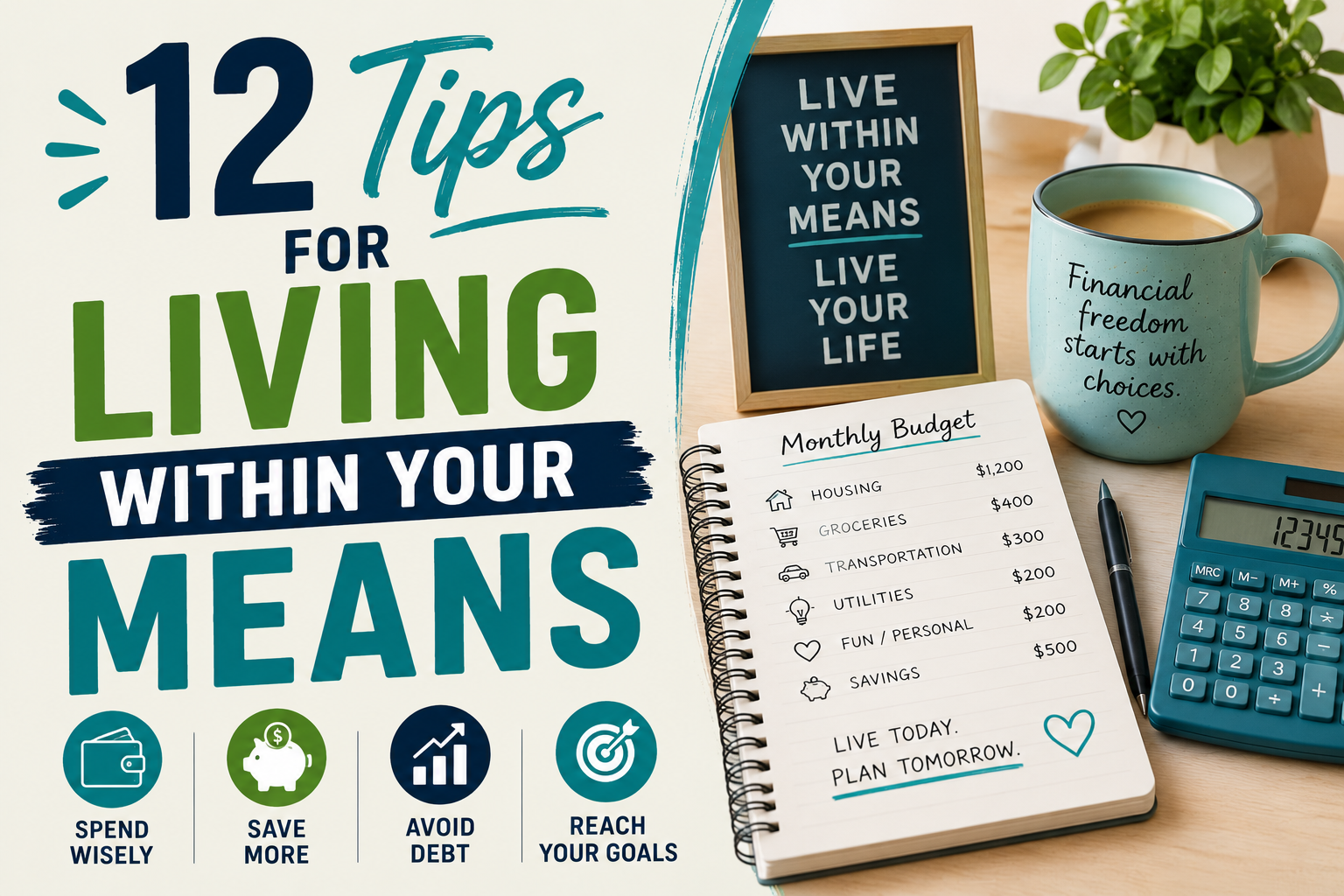
Living within your means does not mean giving up everything you enjoy.
It simply means making sure your spending fits comfortably within the money you actually have coming in.
When you consistently spend less than you earn, it becomes easier to save money, handle unexpected expenses, avoid unnecessary debt, and work toward bigger financial goals.
These 12 practical tips can help you live within your means without making your everyday life feel overly restrictive.
12 Tips for Living Within Your Means
- Know How Much Money You Actually Bring Home
- Track Where Your Money Goes
- Create a Realistic Monthly Budget
- Separate Needs From Wants
- Save Money Before You Spend It
- Keep Housing Costs Manageable
- Be Careful With Lifestyle Creep
- Use Credit Cards Wisely
- Plan for Irregular Expenses
- Wait Before Making Bigger Purchases
- Find Less Expensive Ways to Enjoy Life
- Review Your Finances Regularly
1. Know How Much Money You Actually Bring Home
Before deciding how much you can afford to spend, you need to know how much money you actually have available.
Focus on your take-home pay rather than your gross salary. Your take-home pay is what remains after taxes, insurance, retirement contributions, and other deductions.
If your income changes from month to month, consider building your budget around a conservative estimate rather than your best month.
Pro Tip: Base your lifestyle on dependable income. Treat bonuses, commissions, tax refunds, and other occasional income as extra rather than money you automatically need to spend.
2. Track Where Your Money Goes
It is difficult to change your spending habits if you do not know where your money is going.
Review your bank and credit card transactions from the last few months. Group your spending into categories such as housing, groceries, restaurants, transportation, subscriptions, shopping, entertainment, and savings.
You may discover that several small expenses are adding up to much more than you expected.
3. Create a Realistic Monthly Budget
A budget should help you make decisions, not make you miserable.
Start with your monthly income and subtract your essential expenses. Then decide how much you can reasonably dedicate to savings, debt payments, entertainment, shopping, and other flexible expenses.
Do not create a budget that is so strict that you are unlikely to follow it.
A realistic budget that you can maintain is much more useful than a perfect budget you abandon after two weeks.
4. Separate Needs From Wants
One of the simplest ways to control spending is to understand the difference between something you need and something you would simply like to have.
Housing, basic groceries, utilities, insurance, and necessary transportation are generally needs.
Restaurant meals, upgraded electronics, premium subscriptions, frequent vacations, and impulse purchases are usually wants.
There is nothing wrong with spending money on wants. The goal is simply to make sure your wants are not preventing you from paying for necessities or reaching important financial goals.
5. Save Money Before You Spend It
Waiting until the end of the month to save whatever is left can make saving difficult.
Instead, consider treating savings like another monthly expense.
You can automate a transfer to a savings or investment account shortly after you get paid. Even relatively small amounts can become meaningful when you save consistently.
A good rule to remember: Pay yourself first instead of hoping there will be money left over later.
6. Keep Housing Costs Manageable
Housing is usually one of the largest expenses in a household budget.
A larger home or more expensive apartment can also bring higher utility bills, insurance costs, maintenance expenses, property taxes, and furnishing costs.
When choosing where to live, think about the total monthly cost rather than only the rent or mortgage payment.
Keeping your housing expenses comfortable can give you considerably more flexibility everywhere else in your budget.
7. Be Careful With Lifestyle Creep
When people start earning more money, their spending often increases with it.
This is sometimes called lifestyle creep.
You get a raise, so you upgrade your car. Then you start eating at more expensive restaurants. Soon you add another subscription, take more expensive vacations, and buy nicer things.
Eventually, your new income disappears just as quickly as your old income did.
When your income increases, consider increasing your savings before increasing your lifestyle.
8. Use Credit Cards Wisely
Credit cards can be useful tools, but they can also make it easier to spend money you do not currently have.
Whenever possible, avoid using credit cards to support a lifestyle your income cannot comfortably afford.
If you regularly carry balances because your monthly expenses exceed your income, that may be a sign that your spending needs to be adjusted.
Interest charges can make purchases considerably more expensive and make it harder to get ahead financially.
9. Plan for Irregular Expenses
Not every expense happens every month.
Car repairs, home maintenance, holidays, insurance premiums, school expenses, medical bills, annual subscriptions, and vacations can easily disrupt a budget if you do not prepare for them.
Estimate how much you may spend on these expenses during the year and set aside a little money each month.
For example, if you expect an annual expense to cost $600, saving $50 each month can make that bill much easier to handle when it arrives.
10. Wait Before Making Bigger Purchases
Impulse buying can quickly work against an otherwise good budget.
Before making a nonessential purchase, give yourself some time to think about it.
For smaller purchases, waiting 24 hours may be enough. For something more expensive, consider waiting several days or even a few weeks.
Ask yourself:
- Do I actually need this?
- Will I still want it next week?
- Can I comfortably afford it without using debt?
- Is there a less expensive alternative?
- Would I rather put this money toward another goal?
You may be surprised how often the urge to buy something disappears.
11. Find Less Expensive Ways to Enjoy Life
Living within your means should not mean eliminating everything fun from your life.
Instead, look for ways to get more enjoyment from the money you choose to spend.
Cook at home and invite friends over instead of always meeting at restaurants. Explore parks, beaches, hiking trails, community events, libraries, and free local activities.
Cancel subscriptions you rarely use and keep the ones you genuinely enjoy.
The goal is not to spend as little as possible. It is to spend intentionally on the things that actually improve your life.
12. Review Your Finances Regularly
Your budget should change as your life changes.
Income can increase or decrease. Rent and insurance rates change. Families grow. Cars need replacing. Priorities shift.
Set aside a few minutes at least once a month to review your spending, savings, upcoming expenses, and financial goals.
If something is no longer working, adjust it.
Signs You May Be Living Beyond Your Means
Overspending is not always obvious. You may be paying every bill on time while still stretching your finances too far.
Some warning signs include:
- ✔ Regularly spending more than you earn
- ✔ Carrying growing credit card balances
- ✔ Having little or no emergency savings
- ✔ Using credit for normal everyday expenses because cash is unavailable
- ✔ Frequently overdrawing your checking account
- ✔ Being unable to handle an unexpected expense without borrowing
- ✔ Increasing your spending every time your income increases
- ✔ Having no money available for long-term goals
One of these does not necessarily mean you have a serious financial problem. But if several sound familiar, it may be worth taking a closer look at your spending.
A Simple Way to Start Living Within Your Means
If changing everything at once feels overwhelming, start with four basic steps:
- Spend wisely. Know the difference between what you need and what you want.
- Save consistently. Put aside money whenever you get paid.
- Track your money. Know where your income is actually going.
- Focus on what matters. Spend more intentionally on the things you truly value.
You do not have to completely transform your finances overnight.
Small improvements made consistently can have a much bigger impact than drastic changes that only last a few weeks.
Frequently Asked Questions
What does living within your means actually mean?
Living within your means generally means keeping your spending at a level your income can comfortably support while leaving room for savings, unexpected expenses, and financial goals.
Can you live within your means and still have fun?
Absolutely. Living within your means is not about eliminating entertainment, travel, restaurants, or hobbies. It is about making sure those expenses fit within your overall financial situation.
How can I stop spending more than I make?
Start by tracking your spending and identifying where your money is going. Then look for expenses that can be reduced without affecting necessities. Creating spending limits for flexible categories can also help.
Should I save money if I have debt?
Building at least some emergency savings can help prevent unexpected expenses from creating additional debt. How you divide additional money between savings and debt repayment will depend on your individual financial situation.
How often should I review my budget?
A monthly review works well for many households. You should also revisit your budget whenever your income, housing costs, family situation, or other major expenses change.
Spend With Purpose
Living within your means is less about saying no to everything and more about deciding what deserves your money.
Know what you earn, understand where your money goes, prepare for future expenses, and leave yourself room to save.
Over time, those habits can give you something much more valuable than another purchase: greater financial flexibility and more control over your money.
You do not need a perfect budget. You need a financial plan you can realistically live with.